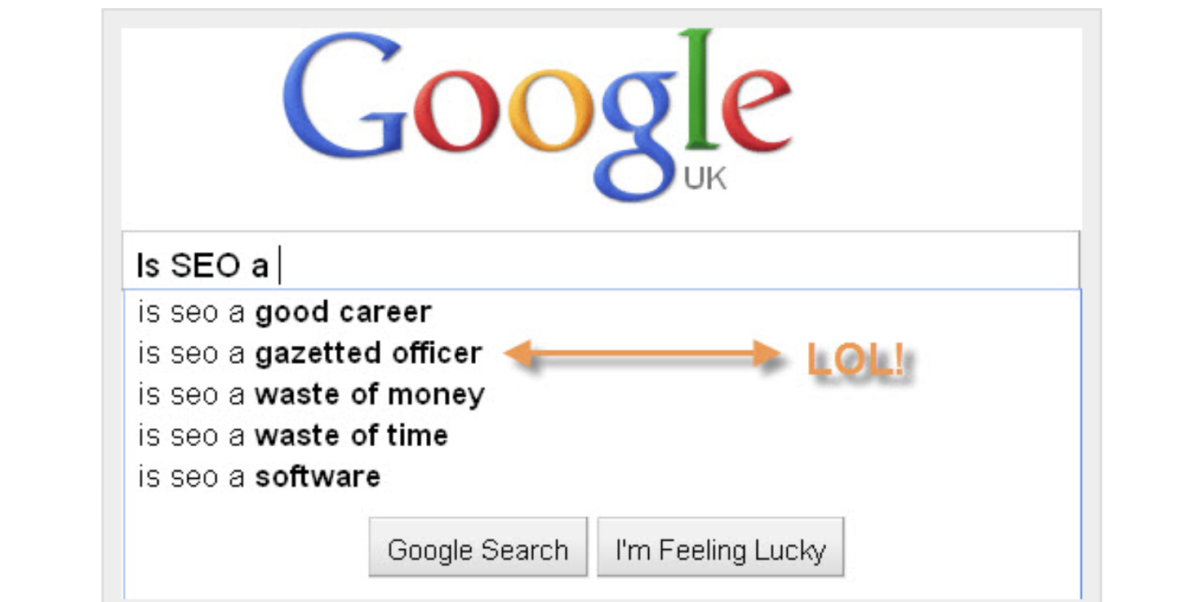
Google Suggest is a Reputation Management Nightmare at times. A number of companies have been hit and hurt by results that show up with “Company Name + Scam” for example. The problem with those results is that when users see the suggestion, they are immediately tempted to click on them, as opposed to their original query.
In fact, google have been sued in France successfully and forced to remove some negative suggest results .
Is It Costing Businesses Money?
The other effect is financial. Ever seen Google Suggest results for businesses that run Promotional or Voucher Codes?

Currys Voucher and Discount
The obvious impact is that users are tempted to find a discount or voucher code , even though their original journey would have been to the brand. This means that a number of Promo Code websites are profiting from Google Artificially showing those suggest phrases.
So How Does Google Suggest WORK?
Andy Beal who runs the awesome reputation management tool trackur, suggests (excuse the pun) that user behavior and search volume impacts google suggest:
In practice, it’s not quite that simple. After some testing, it appears that Google Suggest takes into account the following:
1. What was the first keyword search? For example, someone searches for my company, Trackur.
2. They then decide to refine those results by changing their search to “Trackur Free”–which was what they were looking for all along.
3. If enough people make that refinement, compared to simply searching Trackur, then it starts showing up in Google Suggest.
This is a theory adopted by a number of SEOs. In fact, a very good friend of mine, Brent Payne manipulated Google suggest just to show that sheer volume CAN change those suggest results. The first test worked and failed, while the result of the second is still live:
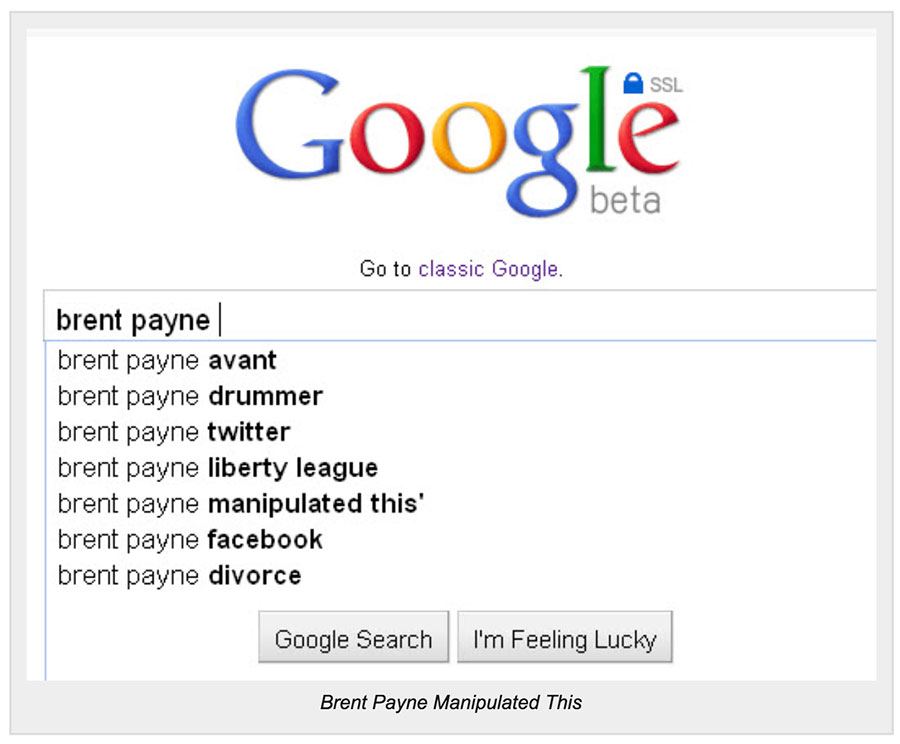
Brent Payne Manipulated This
The Alternative Theory
The problem with the above method of manipulation is that it requires huge volume, and cost. It also sends some sort of manipulation signals, and can be caught. So how can you affect Google Suggest without the use of Mechanical Turk or other large scale manual manipulation techniques?
Let me take you to a post from 2009 that gave me a “tubelight” moment (bolding mine):
google suggest results are hurting my business. When typing in my domain (which people do for whatever reason in a search engine) it shows “MyDomain.com” as the 1st result but shows my domain with negative words about my domain as the 2nd and final suggestion “MyDomain.com sucks“. Im needing to alter the google suggestions. I saw a competitor of mine had this “sucks” term listed on their site at one point but am not sure if thats the reason its now suggested and connected to my domain. I doubt many people would actually search for “www.mydomain.com_sucks”. Its all a bit odd. (Webmaster World)
The question is answered by Robert Charlton – and kinda hits a decent sized nail in the head (see my bolded portion):
suggest was a Labs project before it became a standard feature on the search box. In the Labs incarnation and in the early days of the search box implementation, numbers were returned along with the phrases. The numbers then reflected the number of pages returned, not search popularity.
Ultimately, google dropped the numbers, and I think the official word (or popular supposition) was that they did so because they were distracting and people weren’t really looking at them. But it’s also likely that google dropped these because they had factored other considerations into the personalized (and perhaps other) configurations of the tool, that the numbers therefore weren’t really correlating any more with what the tool was showing in the personalized setup, and it was too complicated to switch displays.
So Can Sheer Volume Of Content Manipulate Google Suggest?
In fact a few weeks ago, Malcolm Coles and I were having a discussion on Twitter about this very phenomenon and he has put together a number of other people reporting exactly what I am – that Google Suggest does NOT only rely on search volume.
I decided to run a few tests. (lazy ones to be honest). In the first instance, I decided to use the power of twitter and RTs to drive indexed content for my two chosen terms, “ha ha ha” and “rofl” to be appended to my name in suggest.
The test with “ha ha ha” had a strange result, instead of going on suggest, it went on to appear in related searches:
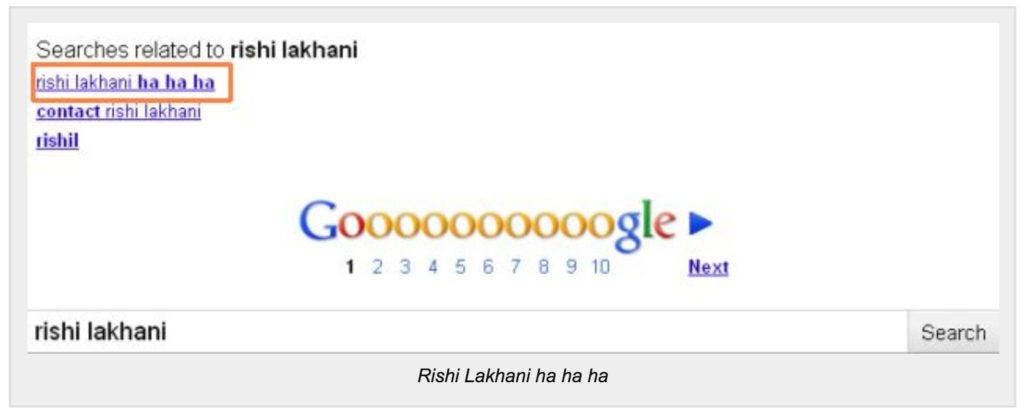
Rishi Lakhani ha ha ha
So I pushed ROFL. And as you can see, as of last week:
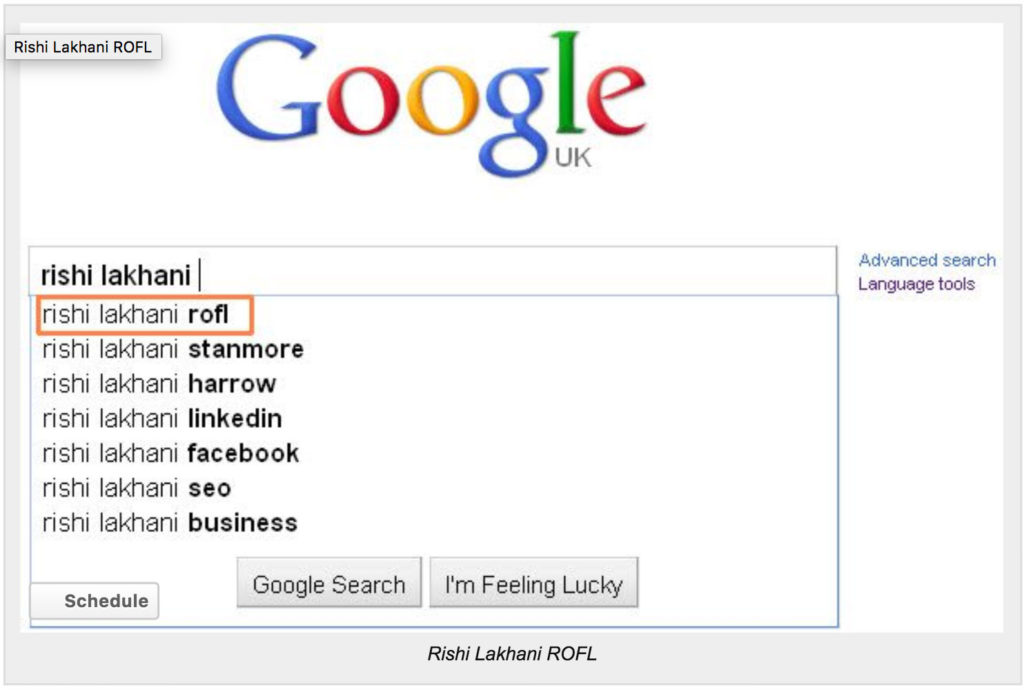
Rishi Lakhani ROFL
Is Manipulating Google Suggest Against Google’s Guidelines?
Simply put yes. Therefore I warn you, you can and probably be penalised for the two suggestions below. This puts Google Suggest (now google Autocomplete) into the blackhat SEO category. Let me pull out a tweet from Danny Sullivan during SMX West
Google views manipulating suggestions as “abuse” & will take “corrective” action as needed #smx #1b2
Using Google Suggest Manipulation for Good

Source kandyjaxx on flickr
I ran a similar test for a brand, where they really wanted to push a product. The sheer volume of search on the brand was quite heavy, so we tried to get the product showing up for google suggest. (I can’t show the result as I have an NDA unfortunately). It worked for a very short time however, and I need to hone the test a bit more.
But how does that help?
- Allows you to force branded queries into common deep product searches (better conversion!)
- Allows you to remove discount queries so as to claim back brand search share and discourage discounting
- Allows you to reputation Manage more easily than using mechanical turk.
Using Google Suggest Manipulation for Profit

Source: http://www.flickr.com/photos/anilmohabir
For lazy affiliates like me, (that’s what the Thinkvisibility Expert Panel call me!), this is probably a decent way to gear up search volume around a brand.
How? Well consider setting up manipulation around a range of words that users may get tempted to click through from Google suggest – scam is probably the best one. Craft a landing page optimized for the word, but pull a bait and switch in the copy.
- User sees Brand + Scam
- User Clicks Through
- Content on page says that no, it’s not a scam!
- Provide link to continue to brand
- Profit!?
This can be geared in many, many other ways… I leave you to think about them independently.
Final Note
I have been berated that my subscribe button isnt big enough. So here you go. Subscribe.
 Subscribe to my feed
Leave a Reply