When it comes to a link building exercise for clients, I tend to prefer a long tail strategy rather than a top level generic strategy. Long tail Link building? What the heck is that? Why don’t we just chuck all our links with the exact anchors that we want for our money words?
To start with, a long tail link building strategy centers around driving a small share of link volume per page on a site, while using 3+ phrases as the anchors. The other element of my long tail link building strategy, is that instead of driving links into the top level pages, I would drive them to tighter match, sub category pages.
How Do I Work on the Long Tail Links?
So take for example an affiliate site that deals with Insurance. Typically, you would have some top level categories like:
- Car Insurance
- House / Home insurance
- Cheap Insurance
- Pet insurance
- Health Insurance
The typical traditional exact match anchor link building looks a bit like this:
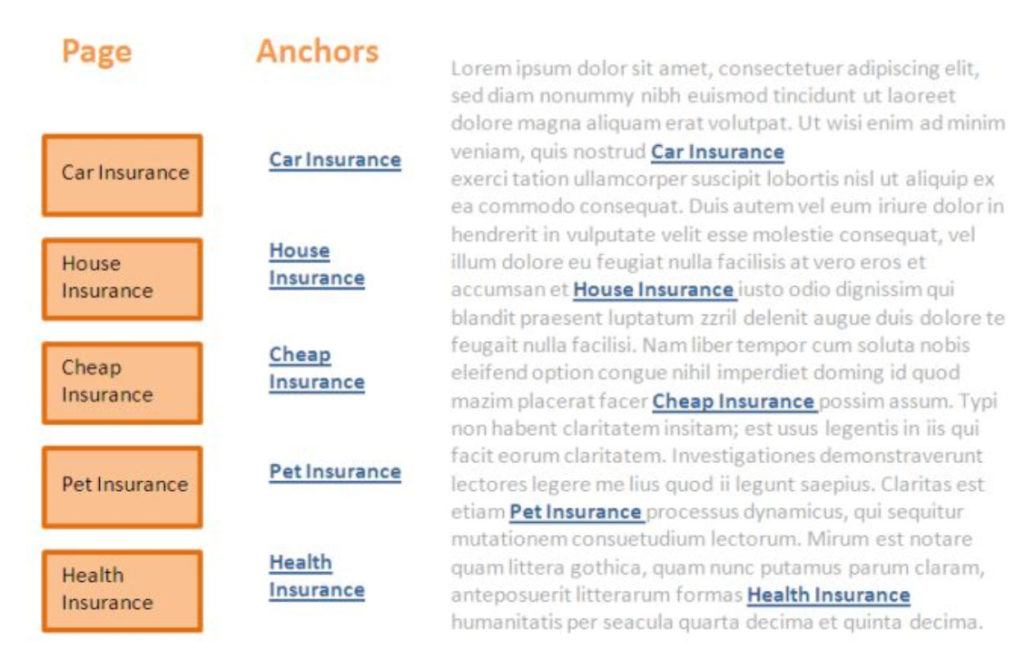
Traditional anchor links
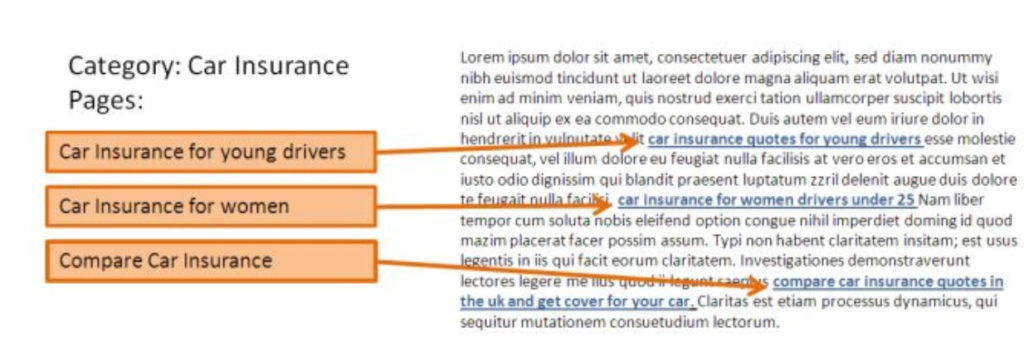
However, my long tail link building is more about building out each one of those categories into sub categories.
A very small sub set of Car Insurance would look like:
- Car insurance for Young Drivers
- Car Insurance for women
- Compare Car Insurance
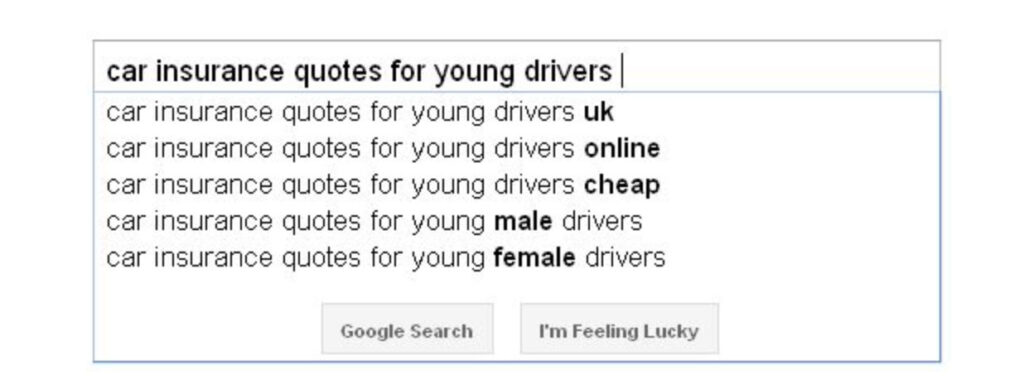
I would then use google suggest to gauge the really long tail versions of queries that match these pages:
And the end result would look a bit like:
Long Tail Anchor Links
So Why The Long Tail Link Build?
I have 5 reasons for building links in this manner:
- It look more natural than exact match anchors
- It’s easier to get these links than your typical one word or two word anchors
- You use googles own data to pick out long tails
- There are knock on effects to the rest of the site
- You build a link profile that is varied, and strengthen the base of the site
Effects Of Long Tail Links
But to give you a more detailed view, when we build links to long tail phrases, we talk about the 4 fold effect:
Effect one
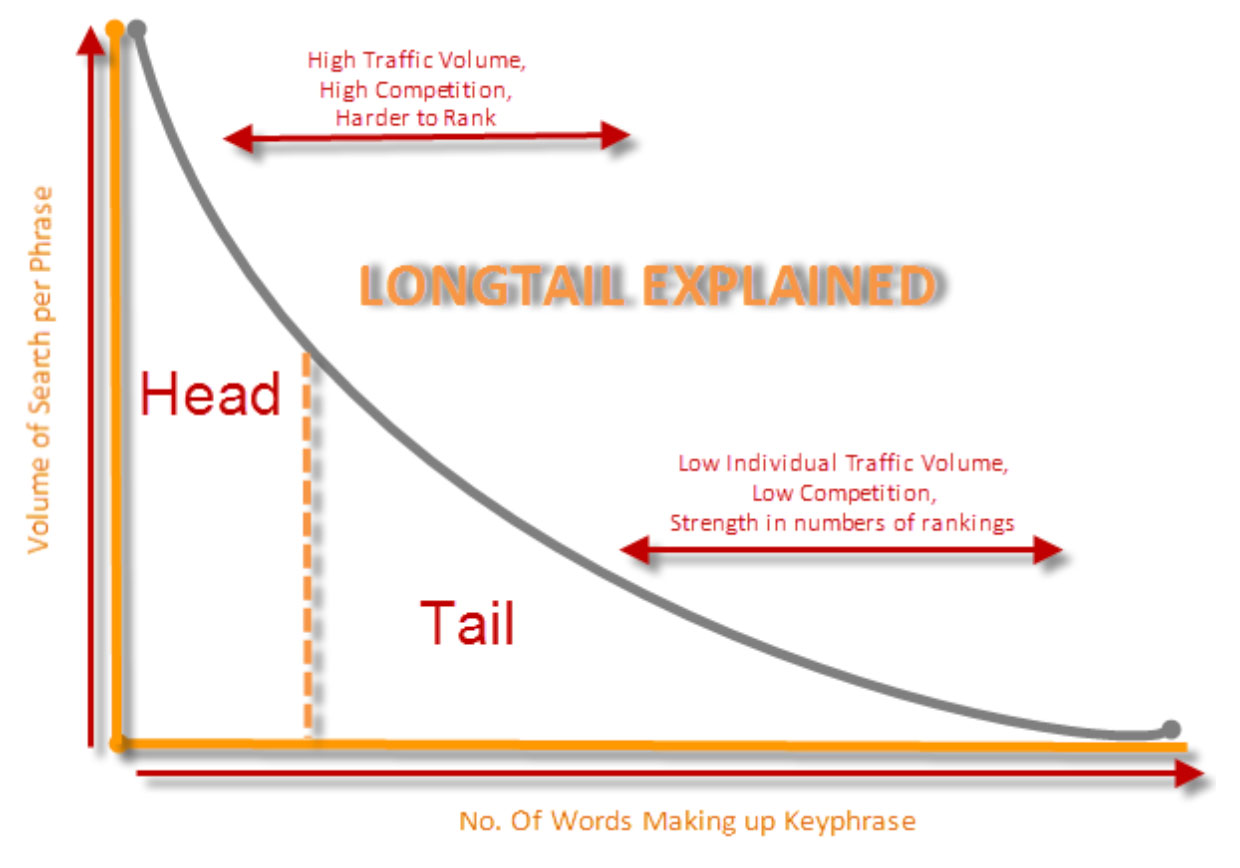
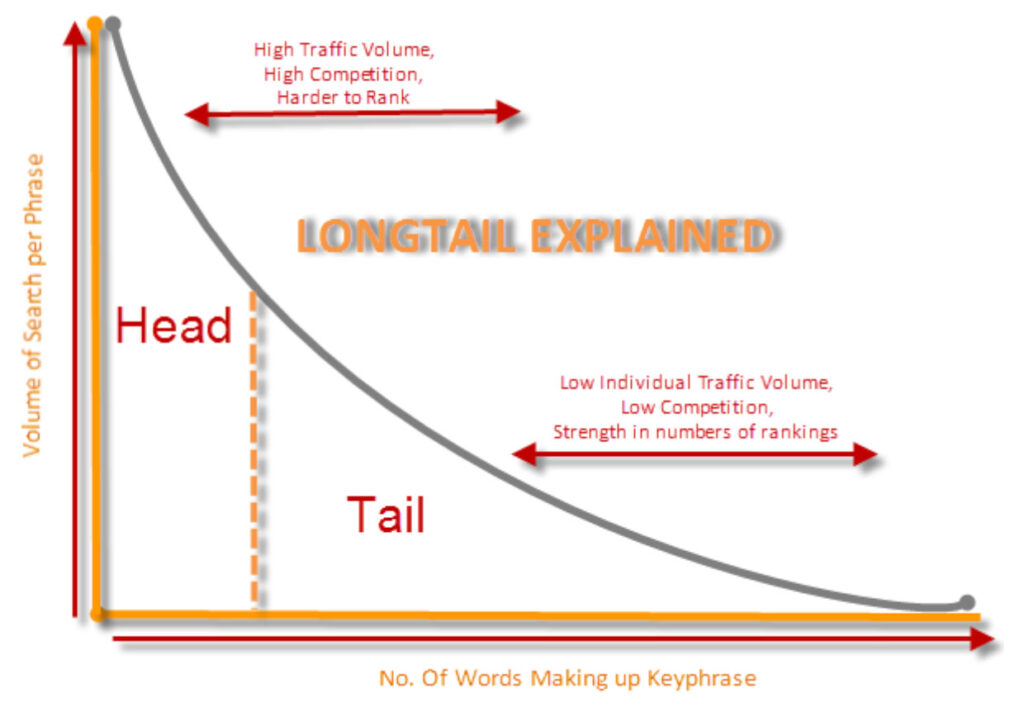
Directly improving the pages relative import to Search Engines for the phrase and its minor variations for that Key phrase, thus ranking well for long tail keywords. In my SERP Sniffing post, I highlighted the importance of ranking for the long tail:
Effect Two
Indirectly affecting that pages ( the long tail page) importance for shorter versions of the hyper link – so where “car insurance quotes for young drivers” is the anchor, both, Car insurance Quotes, and Young Drivers, get affected as other possible key phrase combinations and rank for them, such as “Car Insurance for drivers”, Insurance for Young drivers”.
Effect Three
The page gains authority and can potentially rank for some of the related content on the page, for example if that page had a section: “Risks for Young Drivers”, chances are that the sites ranking for that phrase may go up, and as a result should be correlated with rankings / traffic before the link building was carried out
Effect Four
Over all site authority goes up. As we build a large number of long tail links to deeper content, this has a pyramid effect, where the high base is holding up the tip (in this case the home page) which strengthens for its own content, which then causes a flow of strength through the whole site
Proving the value of a Long Tail Link Building Strategy
Convincing clients used to traditional link building to use this approach may or may not be easy, but you still need to justify that it works. The best way to do this is to:
Take two time points:
- Before the strategy started
- At the end (or current point in) of the campaign
Next, isolate all the traffic to your end target pages from search engines and extract all the referring keywords to those pages for each given time point.
Now compare three things:
1. Volume of traffic, then and now
2. Keywords variations driving traffic, then and now
3. Keywords targeted, vs kws NOT targeted, then and now
If you ran a decent campaign, then the difference would be in the numbers:
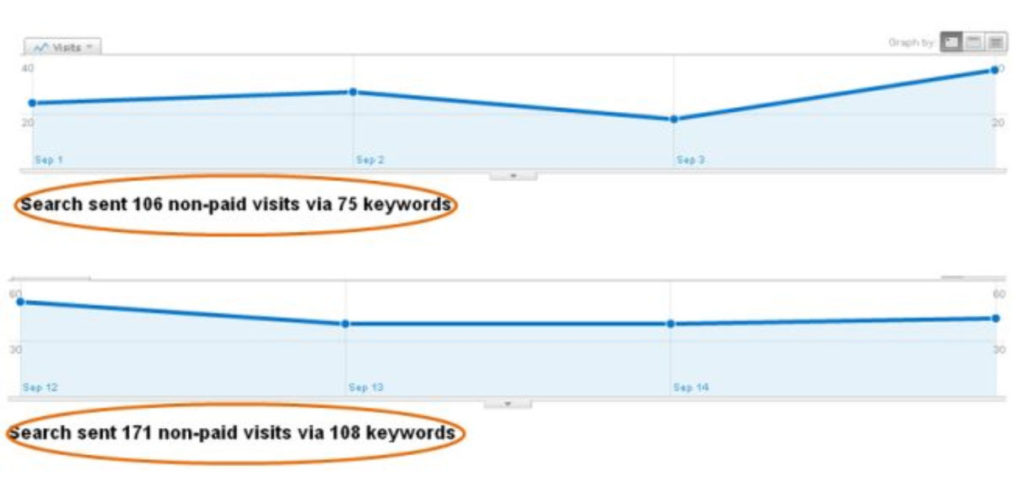
Example of increase in long tail traffic within a week of a single page targeted with 20 Keyword link variations
This example is for one of my small affiliate sites, I isolated a page that had many combo variations via google suggest, then built a series of long tail links. The keyword variation on keyphrase referrers to the page goes up, as well as traffic. Over time, as those links mature further, it will rank higher and higher. If I did the same for the 50 plus pages the site has, the benefits would be higher than trying to get its two word anchors for the home page and trying to compte in that space in the SERPs.
And that folks is my simple guide to long tail link building
Rishi Lakhani is an independent Online Marketing Consultant specialising in SEO, PPC, Affiliate Marketing and Social Media. Explicitly.Me is his Blog. Google Profile


{ 3 trackbacks }
{ 50 comments… read them below or add one }
Good strategy even though sometimes it is challenging to get clients to understand the logic behind this.
Great strategy. Also makes it harder for competitors to nail down your target keywords
How many long-tail keyword phrases can you go after at any time?
If you tell the client that it will take anything from 3-6 months to rank well for these phrases that have small amount of traffic compared to 6-12 months for more competitive phrases that have huge amounts of traffic- in my experience the client always wants the higher traffic keywords.
How do you get round that?
In my experience ranking for long tails is quicker than the turn around you are identifying. Thats because very few people use this strategy – so in most cases your pages will rank faster for the anchors and as a result drive traffic quicker.
Regarding how many long tails – depends on traffic volume, but any phrase with more than 1000 exact searches a month will have 20/50 minimum variations. 2-4 links er variation is average for a decent boost…
So My friend Neyne (SEO Scientist) asked:
The fact is, it isnt unique, the average sites authority will go up as its link building volume goes up – however, in most cases people build links to key pages only, and as such authority flows more to those pages in the short run, via a long tail strategy, you are strengthening a larger part of the site, which is IMHO, more “natural”.
We all know deep links are great, but deeper links like long tails, using longer phrases tends to target more than the honed two word / single word combos.
If you look at it from a visible strngth point of view, I would much rather have a site with (if you use TBPR as page authority indicator) hundreds of internal PR1/2 or open site explorer authority that is greater than 20/30, compared to 10 category pages that have a high TBPR, or OSE Authority of 50/ 60. But thats my honest opinion, may vary with others views…
Oh, OK, thought I was missing something. I totally agree with your preference, among other things, it provides a more organic link profile and makes the site (IMHO) more proof to future algo iterations.
Higher traffic keywords won’t neccessarily convert better. If you are targeting the long tail, these phrases are a lot more specific, this signals a certain amount of intent on behalf of the searcher.
In my experience long tail keywords convert much better than those in the head, even with good SERPS results for those keywords.
You will probably need more long tail keyphrases but that’s not a bad thing – more keyphrases + good quality content will reap rewards.
Excellent advice but as you say, it’s tough getting clients to understand because it is kind of counter intuitive.
At least it gives those that do get it a compeitive edge… for now
It is precisely because it is counter-intuitive that gives it its strength!
What you need to do is unravel the counter-intuitive elements if you want to sell these to your less imaginative clients. Or just tell them that you can do it as an extra with a pay per result.
This is a very clever strategy
So what you’re actually saying is find a ton (20+) of long tail keywords- then for each one of these keywords that has minimum traffic create a small number of links & in your experience in a couple of months they should rank nicely (depending i presume if each page has some decent content)?
Is there a way to use Google suggest without having to manually typing your keyword into Google each time?
You can build a Google Suggest Scraper – like one at SEO Book http://tools.seobook.com/general/keyword-information/ Or this one http://www.rob-millard.com/keyword-expander/
I would focus on proper technical architecture via keyword research. Group your keywords into top level categories then subcategories and tertiary categories as necessary. Eventually you’ll be able to target the long tail in your utility pages.
I wouldn’t straight off suggest going after the long tail without a proper architecture in place. I say this so your footprint looks more natural.
What are your thoughts on this Rishil?
Absolutely – if you dont have the right content architecture, dont bother. The advantages of doing this with poorly constructed content are very low.
Hi Rishil,
Some great points – I’ve recently come across a situation where we have had to be a bit more inventive when it comes to anchor text and long tails. One of the other major benefits that can come from long tail link building is the generally quicker ROI.
The client in question has a few thousand products listed on their site which all fell under some very competitive categories. After analysing the competition we decided the best approach was to build links to the individual products initially as this would provide a quick return in terms of ranking on the less competitive keywords and over time help to strengthen the domain. If we hadn’t gone for the long tail terms no doubt we would still be working on trying to achieve the competitive keywords for months without a return, so it’s a very important consideration.
Thanks for your insights!
There you go David “http://suggest.thinkpragmatic.net/” great post rishil
Editor: I have linked to the tool now – its actually a pretty good one. – Rishi.
This strategy works wonders for in a content strategy plan with a blog or an information rich site. How do you utilize such a strategy for a corporate site? I’ve seen some really ugly spammy looking sites once they start hyperlinking 4+ word queries.
Thanks Rob- Übersuggest is an uber great tool
I’ll definitely focus on applying this to my sites. Thanks for sharing!
Glad to help out, the tail & elbow where it’s at!
Good strategy for long tail link building, but, one thing you forgot to mention is that Long tail keywords (at least for me) tend to have a higher conversion ratio, which is a great way to convince a client to go for the long tail side of things..
Interesting post on anchor text and micro niche content, but I don’t see anything on link building. Where are you getting your links with 13 word anchors as in your example pic? What sort of tactics are you using?
Sadly you have misread the purpose of this post. It’s to identify an alternative to exact anchors. Not link acquisition.
No reason for you to be sad. I followed a link from Sphinn. The purpose wasn’t evident to me in the title. I suppose “link building” means different things to different people. If anyone knows where to get 13 word anchor text links please let me know.
The premise is relatively simple, you use your normal link building methods, the ones you can control the anchors on, for instance press releases, article submissions, blogger outreach, guest posts as well as internal links. But instead of concentrating on short anchors, use long ones.
The few sources of links i mention above are areas that should be part of any decent campaign, AND let you add whatever anchors you want.
Long tail keywords are easier to target and more importantly, it gives you more targeted traffic and lesser bounce rate.
Thanks for the Google suggestion tips
Good points. I am not sure if 2nd point really works. Can you provide some example.
Thanks
Hi,
This article is really an eye-opener, but there is one thing that I don’t understand. What do you mean by “long tail link building”. When I am talking about link building, I mean building links from external sites. So I will search related websites and will ask them to put my link on their blog, or website.
But, when I go to these particular sites with an long tail anchor text and ask them to put the link on their website they eventually end up saying to me that it’s an very ugly link to put on their website.
Right now, I am building links to the homepage and the blog page of my website, and whithin the posts I have two different manners to internal linking.
1) Within the post I add relevant internal links to other posts in my website and in the internal link I have a long tail anchor text
2) I have an Related Posts- section which internal links to other related posts (with their title, which is always keyword rich
Let me know if this strategy is good or the same as yours, or do you mean by link building really external links.. (these are hard to get, especially when they are long tail)
Interesting read. Will test this.
Rishil,
I am a little surprised that you say few people use this, but I am no expert, and you are.
I sort of figured out the argument you put here, and it seems to be working for me, however I use short tails too, just in case
I ‘ve never been a fan of chasing the long tail keywords. I’ve got many one word domains that have 9M, 16M or even 24M exact match searches, like: music, games, news, free, weather.
Eg. if you own free.fr and rank #1 for keyword ‘free’ (9 million searches) and your site gets 2 million visitors a day you can pretty much give up chasing long tail keywords and concentrate on things that are important in your life, i.e. the things that noone else will do for you, which includes creating art, writing books, composing music.
However if you own ‘free dot anything’, it does make sense to target keywords like ‘free games’ , ‘free music’ etc, ie. keywords with excess of 100,000 searches. But 1000 monthly searches? I don’t know, if you can’t outsource it, I wouldn’t bother.
Anyway a great article and advice to someone that can’t afford to wait until the real traffic starts pouring in. If all you have to invest is your time, then this is the way to get started.
This is a great strategy for anchor text especially with a site which is in a very competitive niche.
Thanks.
Excellent article. It supports what Troy said in his webinar on Competitive Research the other evening – “Bottom Up Keyword Domination”. Starting off with Longer Tail Keywords first and working your way up eventually. I definitely have to implement this idea on my new site…
I have just starting using this long tail keyword concept and I can see the value in it. I’m ranking #1 for lots of searches, albeiit, ones with very low volume. However it all adds up. Enough cookie crumbs can make a cookie!
I’ve tried this method and have easily ranked number 1 for many of these keywords almost immediately. Sure, they don’t get much traffic but when you add them together it can be worth while. Enough crumbs equals a whole cookie.
Its really very great process to publish long tail keyword, its really very helpful to generate more traffic then exact match keyword.
Ah, a missing part of your guide is a pointer to what methods one can use to actually get those long tail links, that you say “are easier to get”. hints?
Guest blogging
Nice trick using the Google suggest to gather possible other long-tails. I might also use the Google keyword tool to see if there is any frequency on the phrase, and the Google ‘related searches’ tool under the ‘more search tools’ option to see if there’s anything else I might have missed.
This is a great, simple explanation for the long tail. I can get so focused upon the main keyword phrase in my SEO that I often forget about the long tail, which of course pays off well for the effort. Great idea about using Google suggest too. Thanks.
Great article!
I think this is a great approach for organisations that are focussed on results rather than just what looks good. Sure being number 1 for the top keywords looks great, but being number one for overall traffic to your site looks much much better!
Cheers
Danial
Best long tail research tools? I’ve tried a few but keep going back to Wordtracker. SEO BOOK is ok, but not willing to pay for it. Ad Words tool is n/a and often a great deal of results are omitted.
Great article Rishil – thank you? I like your method – much more natural.
What’s your gut feel – using this method, it is slower, about the same time, or quicker to rank for the primary keyword?
I totally understand the point of the article, but curious why you say about long-tail keywords “it’s easier to get these links than one or two word anchors.”
How is it easier?
This is from experience, esecially if you are trying to gest blog as way of link building. Many bloggers, especially those with high authority dont like exact keywords such as “car insurance” etc that make these posts stand out as natural.
However I see a higher acceptance rate when we use long tail anchors…
Is this method useful for non-English websites?
I must say, that is a very nice that thought through strategy. Although there is a small problem, and that may be to get your clients to comprehend this logic. Anyhow, good luck
Excellent article Rishi. I just re-read it for the 2nd time. It seems so obvious now, and I find myself wondering why anyone wouldn’t use long tail anchor text.
Great article, Rishil! We do our link building the same way and have got very good results from it. Maybe one more positive aspect: The conversion-rate for the long tail keywords is usually much higher, than for short tail keywords, which makes the long tail link building even more effective.
This technique also works for (related) medium or long-tail key phrases. E.g. if you were building a site about ‘white tumble dryers’, you might also build a page on ‘portable tumble dryers’ (if there is such a thing!) Here the phrases are not necessarily any longer than the main phrase, they’re just phrases with far less competition on them and hence easier to rank for.
Thanks for this insightful article, it definitely brings in some decent argument for clients hesitating to spend their budgets on anything else than a few money keywords.
Apparently this is your most shared page