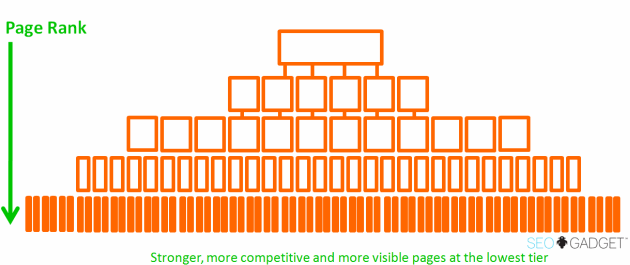
I was very glad to catch the founder of SEO Gadget presenting what I think he is an authority on, Site Architectures. You will see why when you scroll down to the resources part of this presentation. Suffice to say, he has dealt with some heavy weight site structures and is no stranger to the optimisation and manipulations of these for a businesses optimal benefit.
Richard Baxter’s presentations are always very well researched and delivered. In the session on Successful Information Architecture at the A4ULondon Expo 2010, Richard took us on a very detailed journey of understanding, developing, refining and optimising a sites architecture to maximise for SEO potential, yet keep it very user rich and friendly. In fact a couple of his ideas in my opinion would instantly see an increase in conversion. instead of trying to cover the presentation verbatim, I will pull out a couple of key messages which I think one should definately take away over and above the full presentation. (I will highlight these as “Protips“).
Richard starts out with highlighting a bad sitemap and contrasts it with a well thought out, layered keyword category based one:
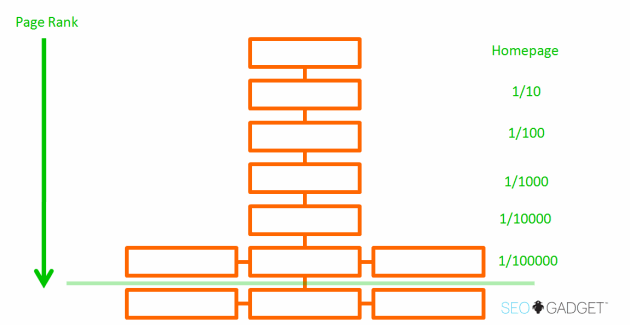
BAD Site Architecture
GOOD Site Architecture
When you look at these images side by side, it seems pretty obvious doesnt it? Unfortunately in my experience many businesses dont think this way – they keep layering categories or content as it develops in what seems to them a “logical” way to manage the content, and not thinking about the other potential issues with poor planning of site content. Richard emphasizes the need for businesses to think top down and plan the way they are developing a sites architecture. And in fact this is a process that should begin with both users and SEO in mind. Richard covered this part of the presentation in a post earrlier this year: Solving Site Architecure Issues.
ProTip 1: Using Keywords to Build Categories and Bases
There are normally many influences to the way a business decides to lay out its site – however for a business that really wants to focus on SEO in the long run, it should use a logical approach to using its keyword data to build this map up. Richard gives a really good example:
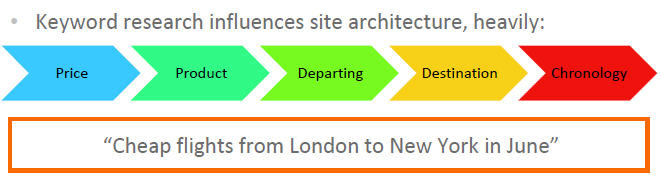
Keyword Research for Site Architecture
As you can see, there is a certain taxonomy that comes out of logical placement of sublayers as part of the hiearchy. If only more businesses did more of this…
ProTip 2: Optimise your Category Pages!
I have often come across businesses that have loads of nice product landing pages, with a nice hiearchy, with well targetted parent categories – but I never thought about the Category Homepages as a focus page – richard highlights this a very good win – for both SEO and Sales conversion. He lists some simple elements that can be used to build a nice category page:
- Getting your Breadcrumbs on the page
- An Appropriate H1
- Use Unique Handwritten Text as an Intro
- Get Your Pagination Right
- Bring in Your Microformats!
- Try bringing in Cross Link Categories (e.g popular categories)
- Also add secondary Cross links to Sub categories (e.g related Categories – mix them up)
- Bring in some User Generated Content
- Use your internal Site search to Populate other deep links
To give a view of something he knocked up as a demo (UPDATE: Richard Posted 5 Category Page Tips To Improve Your SEO) :
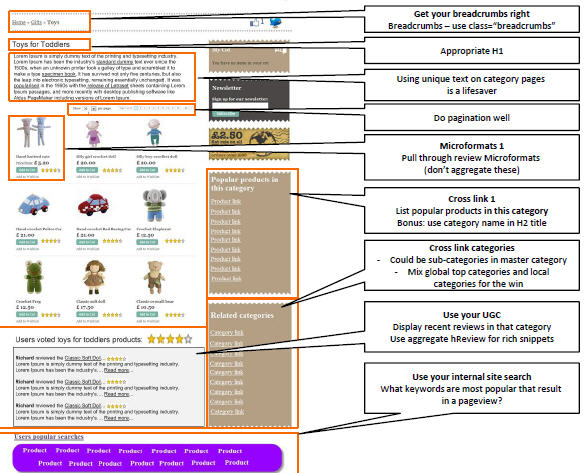
Category Page Optimisation
Summary
We were taken on a journey from discovery to delivery, many of which Richard has highlihgted in previous posts or presentations, but i think this was the first time he attempted (and succeeded!) in delivering a full Site Architecture presentation. The useful resources include links to many different parts oof this presentations in post format that would give life to the slides I have linked to.
The full presentation included best practice as well as some really interesting nuggets. I genuinely reccommend checking out his a4u presentations:
Useful Resources
- Solving Site Architecture Issues
- Measuring Indexation Levels in Site Architecture
- Creating Inspirational Sitemap Architecture Diagrams
- Fixing duplicate content
- Datafeeds and Information Architecture(by Tom at Distilled)
- Diagnosing Web Architecture Issues (presentation)
Rishi Lakhani is an independent Online Marketing Consultant specialising in SEO, PPC, Affiliate Marketing and Social Media. Explicitly.Me is his Blog. Google Profile


{ 3 trackbacks }
{ 9 comments… read them below or add one }
Hi Rishil,
Just thought I’d give my 2p/2c worth on the directory structure debate. From what I’ve seen and what I’ve tested, search engines count the number of clicks to get to a page as a far higher metric than how deep. Consider:
site.com
site.com/widgets/
site.com/widgets/blue/
site.com/widgets/blue/round/
site.com/widgets/blue/round/flashy/
site.com/widgets/blue/round/flashy/best-round-blue-widgets.html
Now you’re 5 directories down… consider a link on the homepage to the final URL, with nice shiny anchor text, meaning one optimised click from home to content for a spider. In my experience, that page will rank just as nicely as a page at site.com/best-round-red-widgets.html with the same or similar link profile.
To be fair – I forgot to highlight this point – Richard did highlight that the click depth for a category advisably should be within 3-4 clicks – you are ablutely right in pointing this out
Hey guys
Click depth is the important factor, where number of physical folders in the URL is a different (and less significant) variable.
Thanks for the kind words Rishi, top writeup!!
great writeup. Particularly love the category page optimisation chart, great to see all of these ideas in one place.
Re folder depth – agree with Andy – but multi folder URL structures cause problems when you try to do multifaceted categorisation – same product in 2 different categories – with mutli folder URLs you can end up with multiple URLs for the same product – that’s another reason why I prefer product URLs straight off the root.
Exactly. SEs do process a dynamic breadcrumb like A::B::C::D::E on site.com/x just fine. They look at links but don’t count slashes in URIs. When there’s no ever static hierarchy, don’t create artificial hierarchies in URIs.
Finally, Someone got it right and had killer graphics to boot. Nice representation (particularly on click depth) or hops whatever preferred nomenclature one opts for.
In my experience, the more hops one has away from the root, the more internal and deep links are required to create buoyancy in the SERPs for specific keywords (depending on the pages and sites competing for those keywords) and their respective authority.
If a site is developed properly (as a result of superior site architecture) then it will send PageRank into the deeper nested pages faster as a result of managing the link equity, which also has the added benefit of ranking higher on less inbound deep links.
I have experimented with this and created a site in the cosmetics industry (within a 4 month period) that outranked drugstore.com and walgreens as well as ranked right next to major cosmetic companies, their brand names, etc. and had less than 200 inbound links.
Just to make the point that its not always about the off page ranking factors. Does this work, absolutely, the only thing I would have added was using dynamic linking to sculpt the on page link equity further, but great stuff.
Agree with Jaamit – the extra subfolders can obfuscate the URL displayed in the serp snippet too. I kind of try to avoid that where I can.
How about we go back a few years and just do:
site.com/blue-widgets
site.com/blue-flashy-widgets
And keep EVERYTHING in the root?
Hi – very great web site you have established. I had fun reading this posting. I had an urge to publish a remark to let you know that the design of this website is very aesthetically delightful. I used to be a graphic designer, now I am a copy editor for a merchandising firm. I have always enjoyed playing with computing machines and am attempting to learn website building in my free time (which there is never enough of lol).